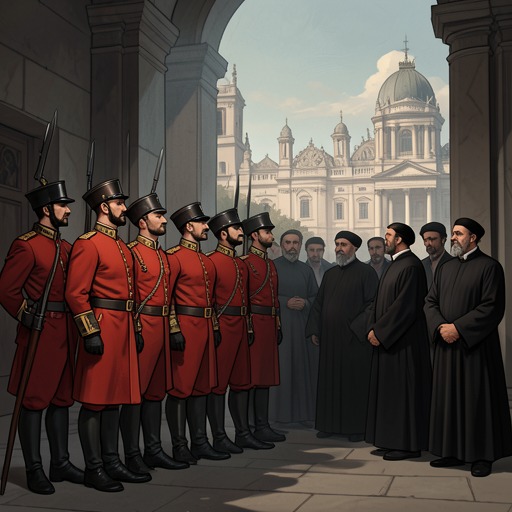
Fragmentation of the Han empire into the Three Kingdoms
The Romance of the Three KingdomsThe Fragmentation of the Han empire into the Three Kingdoms names both the political collapse at the heart of the novel and the division that defines its age. The Han court’s loss of authority allows rival leaders to carve kingdoms from the empire, turning a dynastic crisis into a contest over territory, allegiance, and the right to rule. The novel frames that division not as an isolated rupture but as another turn in a long cycle of empire, disorder, and reunification.
A recurring cycle of unity and division
The narrative places the Han’s collapse in a succession of earlier political upheavals. The Zhou dynasty gave way when seven kingdoms fought until Qin conquered them; Qin soon fell, and the competing forces of Chu and Han fought until Han reunited the realm. Much later, an uprising again divided the empire, before Emperor Guang Wu restored unity. The division under Emperor Xian thus repeats a pattern the narrative presents as recurrent: a unified realm breaks apart through conflict, and a new power eventually gathers it together.
The account also identifies failures within the Han court as immediate causes of the final rupture. Emperor Huan favored eunuchs over men of distinction and integrity. His successor, Emperor Ling, failed to support a palace conspiracy against them; its instigators were executed, and the eunuchs thereafter held effective control, with nobody able to stop them. The empire’s disintegration is therefore linked to more than competing armies: the institutions meant to govern the realm have already been compromised.
Rival rulers and contested legitimacy
As the empire falls apart into a world of warlords and armed factions, three leaders emerge as the defining powers of the new order: Liu Bei, known in the novel as Xuande, Cao Cao, and Sun Quan. Each establishes a kingdom by taking territory from the dying Han realm. Their rise turns the political vacuum into a three-sided struggle, while the survival of the Han name remains a crucial measure of legitimacy.
The conflict is not simply between rulers who openly claim the same title. Cao Cao controls the emperor and the northern court, giving him the authority and allegiance associated with the Son of Heaven. Xuande, by contrast, invokes his distant descent from the imperial family and his commitment to preserving Han rule. When Kong Ming assesses the strategic situation, he describes Cao Cao as powerful not only through his army but through his control of the emperor, and identifies Sun Quan’s established southern power and popular support as grounds for alliance rather than enmity. The division consequently involves both military strength and competing claims about who may govern legitimately.
That tension becomes explicit after Xuande’s successes in the west. His commanders urge him to become emperor, and Kong Ming argues that Cao Cao has usurped the true ruler’s place while Xuande has brought peace to the regions he controls. Xuande fears that accepting the throne would make him appear a rebel, despite his Han lineage. Kong Ming counters that a fractured country longs for a true emperor and that refusing the role could cost Xuande popular support. The episode shows how the breakup of the Han produces a crisis of succession as well as a contest between armies: even an apparent restoration of imperial authority risks being read as another act of usurpation.
Fragmentation on the ground
The weakening of the central court leaves room for regional regimes to govern with considerable independence. In Hanzhong, Zhang Lu’s community has been able to persist for thirty years beyond the court’s close concern. The account describes a locally organized system under libationers, with public provisions of rice and meat for the poor, rules against taking more than one honestly needs, and religious practices through which illness and wrongdoing are addressed. The imperial court has given Zhang Lu the title of prefect and required ordinary tax payments, but that nominal recognition does not amount to effective central control over the region.
Once Cao Cao’s growing power threatens Hanzhong, Zhang Lu considers declaring himself prince of Hanning and leading resistance. His adviser Yan Pu instead points to the region’s wealth, grain, natural defenses, and influx of refugees, and urges an expansion into the forty-one departments of the western Riverlands under Liu Zhang’s weak rule. Zhang Lu orders his brother Zhang Wei to summon the army. This regional maneuvering makes the larger fragmentation concrete: local rulers assess resources and defenses, contemplate independence, and pursue territory while the Han court can no longer reliably contain them.
The novel also portrays the southward campaigns of Xuande’s kingdom as an extension of this divided political landscape. After the governors’ revolt is quelled, Meng Huo calls the chieftains of three valleys to unite against the Shu invasion, each bringing about fifty thousand men. Later, with the surviving forces retreating to the Silver Pit hills, the narrative describes the Man rulers’ ancestral temple and distinctive customs. After repeated defeat and capture, Meng Huo submits; Kong Ming appoints him ruler over lands conquered by Shu, and the people rejoice. Here expansion does not end simply with conquest: the new kingdom incorporates a local ruler and population, showing a different means by which power is extended within the fractured realm.
The military mechanics of a broken empire
With no single authority able to settle disputes, campaigns depend on local intelligence, supply, terrain, and deception. At Wan Castle, Jia Xu watches Cao Cao’s attention to the southeastern wall and recognizes that the apparent preparations in the northwest are a feint. He advises Zhang Xiu to conceal elite troops near the vulnerable southeastern approach while placing ordinary people in armor on the northwest wall. The proposed trap rests on reading an opponent’s deception and exploiting a city’s actual defenses—small-scale evidence of how fragmented sovereignty makes military calculation decisive.
The struggle at Guandu likewise turns on resources as well as numbers. Yuan Shao leads a huge army, while Cao Cao can muster only about a tenth as many troops. Xun You warns that Cao Cao’s veterans may be able to face ten times their number, but their supplies will run out if the campaign drags on; he urges an immediate attack, and Cao Cao advances. The confrontation is thus shaped by the limits of supply, not simply by rival claims or raw force.
Kong Ming’s campaign at Bowang presents another instance of forces being organized through deception and coordinated orders. Guan Yu is told to let the invaders pass, then attack their rear and supply train when flames appear; Zhang Fei is assigned the army stores at Bowang; other commanders prepare fires in the ravine; and Zhao Zilong is to lead an advance party that pretends to flee. Guan Yu and Zhang Fei doubt the plan, especially because Kong Ming will not be near the fighting, but Xuande insists they cooperate. The divided empire’s wars are repeatedly decided by such arrangements: separate forces, timed signals, and a commander’s ability to make the enemy misread what is happening.
The fog-bound arrow stratagem further shows how a commander can turn an opponent’s resources against him. Hearing what appears to be an attack, Cao Cao orders his archers and crossbowmen to fire into the fog; ten thousand weapons discharge toward the noise. The boats under Kong Ming’s command carry bales of straw wrapped in black, which gather arrows until the fog lifts and they can return safely. The episode makes military ingenuity one of the means by which smaller or resource-constrained forces survive in a contest among rival states.
At Jieting, by contrast, strategic failure exposes the cost of mistaking book learning for judgment in the field. Ma Su rejects Wang Ping’s advice to defend the road and takes the hill, where his men are cut off from water. As thirst drives them to desert, Ma Su’s army disintegrates; Wang Ping cannot rescue him, and Zhang He pursues the retreat. The loss of the city and the heavy casualties that follow show how a single command decision can alter the balance between the divided kingdoms.
A political settlement without restored Han unity
The novel’s three kingdoms are not merely names for territories; they mark the replacement of a weakened imperial center by rival regimes with their own rulers, armies, and political bases. Xuande’s western kingdom is based in Sichuan, with its capital at Chengdu. In the narrative, its growth can be presented both as military expansion and as a claim to restore Han rule, while Cao Cao’s control of the emperor gives northern power a different kind of authority. Sun Quan’s southern regime rests on the strength and support Kong Ming identifies as grounds for partnership.
The settlement remains unstable and morally contested. Xuande’s declaration as emperor is presented by his supporters as a response to the usurpation of the true ruler and a means of serving the people; Xuande himself recognizes that it may look like rebellion. In this clash of interpretations, the Han’s fragmentation is not resolved simply by naming three kingdoms. The old empire’s political language persists inside the new order, even as regional rulers establish the powers that make its division real.